
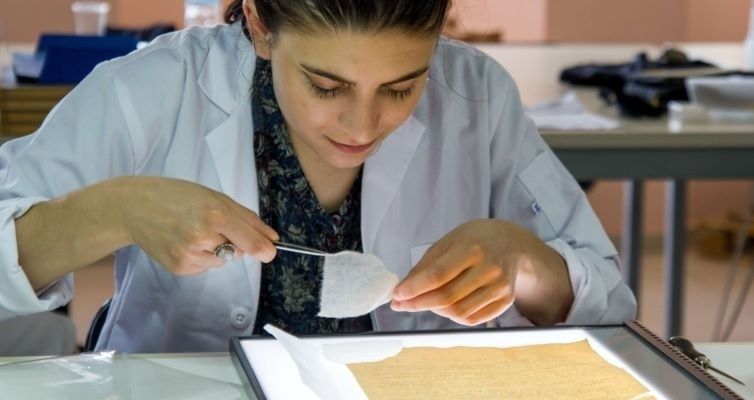
Stopping Time: How Archivists Protect Fragile Paper and Pigments from Fading
The Quiet Chemistry That Threatens Our Paper Heritage
Paper often appears sturdier than it really is. A family letter, church register, land deed, photograph, or hand-painted poster may survive for decades in a drawer, yet its fibers and colorants are continually reacting with light, oxygen, moisture, heat, and pollutants. Historical inks can sink into paper, migrate through it, or become chemically aggressive. Pigments may lose their color, while dyes can fade unevenly and leave behind altered images that no longer resemble the original.
These objects carry more than information. They preserve names, relationships, local decisions, artistic traditions, and evidence of ordinary lives. For families and community archives, a handwritten recipe or a school certificate may be irreplaceable even when its monetary value is modest. The encouraging news is that conservation science has identified many of the forces behind deterioration. With thoughtful storage, careful handling, and realistic environmental control, households and small repositories can prevent much of the damage before it becomes irreversible. Even choices about archival and waterproof ink can help explain why some newly created records are better prepared for the future.
Why Colors Fade and Fibers Crumble
Light is one of the most visible causes of fading, but the damage is chemical as well as visual. Ultraviolet radiation carries enough energy to break or alter molecular bonds in dyes, pigments, and paper. Visible light can also contribute to photochemical reactions, especially when exposure is prolonged. The result may be a gradual loss of saturation, a shift from blue to gray, yellowing of paper, or a sharp difference between an exposed margin and a protected area beneath a mat. Once a colorant has chemically changed, lowering the light level later cannot restore it.
Modern pigment-based inks are generally more stable than many dye-based inks because pigments consist of solid particles that are less likely to dissolve, migrate, or break down quickly under light. High-quality pigment printing systems may be designed for very long display life, although actual performance depends on the paper, framing materials, humidity, light intensity, and the specific ink formulation. Dye-based inks can look exceptionally bright when new, but some are more vulnerable to ultraviolet exposure and oxygen. Terms such as “permanent,” “document,” and “waterproof” should not be treated as interchangeable. Waterproofness describes resistance to liquid after drying; it does not automatically promise long-term lightfastness or chemical safety for the paper.
Historical iron gall ink illustrates a different danger. Used widely for centuries, it was made from oak galls, a solvent, ferrous sulfate, and gum arabic. Its blue-black mark was valued for permanence, but poorly balanced or aging formulations can release acid and leave excess iron in the paper. These substances promote hydrolysis and oxidation, shortening cellulose chains and making the support brown, brittle, and weak. Conservators often observe a progression from halos around written lines, to ink showing through the reverse, to cracking and eventual loss of the written areas. Such documents should be handled minimally and assessed by a trained conservator before cleaning, flattening, or repair.
| Ink type | Chemical base | Typical stability | Historical or practical risks |
|---|---|---|---|
| Pigment-based ink | Solid color particles suspended in a carrier | Often good light resistance when well formulated | Can abrade or flake from unsuitable surfaces; quality varies by product |
| Dye-based ink | Colorant dissolved in liquid | Often more vulnerable to light and moisture | Fading, bleeding, and color shifts may occur over time |
| Iron gall ink | Tannins, iron salts, solvent, and gum arabic | Strong initial mark, but chemically unstable in some formulations | Acid and iron can corrode cellulose and cause cracking or ink loss |
| Waterproof ink | Varies, often resinous or otherwise water-resistant | Resists liquid after drying, but lightfastness varies | May bleed, feather, or become brittle depending on formula and paper |
How Modern Conservators Predict and Measure Decay
Conservators do not have to rely only on visual judgment when deciding whether a color can safely be exhibited. A microfading tester, or MFT, directs controlled, intense light onto a very small area and measures changes in reflected color. The test accelerates photochemical aging, allowing researchers to estimate how a dye or pigment may behave under gallery lighting. Research described by Yale researchers using microfading technology indicates that roughly one minute of testing can represent about a year of aging under particular exhibition conditions. The exact comparison depends on the instrument and material, but the principle is valuable: vulnerability can be assessed with essentially no visibly altered spot on the artifact.
This information supports practical decisions rather than replacing professional judgment. A highly sensitive photograph might be displayed briefly at a low light level, while a more stable document could remain on view longer. Community archives can use the same logic even without owning specialized equipment by identifying high-risk materials and adopting conservative policies.
- Record which objects are most light-sensitive, especially colored photographs, textiles, watercolors, and fugitive dyes.
- Rotate vulnerable materials rather than displaying them continuously.
- Use copies or high-quality digital surrogates for public handling and frequent exhibitions.
- Document exposure history, because cumulative light matters even when each individual display seems harmless.
The Science of Microclimates in Collection Care
A microclimate is a small, managed environment inside a case, box, drawer, frame, or enclosure. Instead of forcing an entire building to remain at strict conditions, collection staff can create a more stable space around a sensitive object. Properly sealed enclosures may use conditioned silica gel or another humidity buffer to limit rapid changes in relative humidity. This is especially useful for small museums, historic buildings, and family collections where whole-room climate control is expensive or unavailable.
Temperature and relative humidity should be stable rather than repeatedly rising and falling. Excess humidity encourages mold, corrosion, adhesive failure, and swelling of paper fibers. Very dry conditions can make paper and coatings brittle, while repeated cycles cause materials to expand and contract at different rates. Sustainable collection care can include better building envelopes, shade, improved case seals, data loggers, and object-specific enclosures. Museum examples discussed by the American Alliance of Museums show how localized control can protect sensitive objects while reducing the energy required to condition every gallery equally.
Museum-Grade Practices for Home and Community Archives
Good preservation begins with the enclosure and the surrounding environment. Store paper in a cool, stable, clean location away from attics, basements, kitchens, exterior walls, radiators, and direct sunlight. Avoid ordinary cardboard, newspaper, colored tissue, adhesive-backed albums, and plastic sleeves that become sticky or release damaging chemicals. Look for acid-free, lignin-free folders and boxes made from stable archival paperboard. Polyester, polyethylene, or polypropylene enclosures are generally preferable to unknown plastics, provided the object is not trapped in a humid or poorly ventilated setting.
Handling deserves equal attention. Clean, dry hands are appropriate for many paper items because gloves can reduce tactile sensitivity and catch on edges. Nitrile gloves are useful for photographs, metal components, or objects that should not receive skin oils. Cotton gloves are less desirable for delicate paper because they can reduce grip and snag fibers. Support sheets should be used when moving weak, folded, or oversized documents. Never force a page flat, remove a photograph from a stuck album, or apply household tape to a tear. A conservator can recommend safe treatment when the material is brittle, flaking, mold-affected, or historically significant.
- Survey before sorting. Note tears, stains, mold, flaking media, unusual odors, and signs of insect activity. Separate actively damaged items from clean material and seek specialist advice if mold is present.
- Choose stable containers. Use archival folders, four-flap enclosures, photograph sleeves, and boxes that fit without crushing or excessive empty space. Materials should be labeled as acid-free and preferably lignin-free, with no adhesive touching the original.
- Store flat when appropriate. Letters, certificates, and photographs should generally lie flat with adequate support. Oversized works may need a rigid, archival board and a custom enclosure rather than being folded.
- Reduce light exposure. Keep originals in darkness for routine storage. When displaying them, use filtered glazing, low illumination, curtains or blinds, and short exhibition periods.
- Create access copies. Scan or photograph records carefully, preserve descriptive information, and provide copies for family research or community use. Digital files also need more than one backup and periodic format review.
Commercial products require careful reading. “Archival” on a package is helpful but not always specific enough. Check for acid-free and lignin-free claims, buffered paper when appropriate, and plastic identification. For new writing, a tested document or archival ink is more suitable than choosing solely on the basis of the word “waterproof.” Product performance depends on the pen, paper, drying time, and storage conditions, so an inconspicuous test can reveal feathering or bleed before a significant record is created. Framing also matters: use a window mat so the paper does not touch glazing, avoid wood or acidic backing that is not isolated, and select ultraviolet-filtering glazing when display is necessary.
Preserving Living History for Generations to Come
Preservation is less about costly technical wizardry than about preventing avoidable stress. Darkness during storage, stable humidity, clean enclosures, careful support, and limited handling address the main causes of damage for many paper collections. A simple temperature and humidity log can reveal a damp cupboard or overheated room before mold or brittleness becomes obvious. Regular review also helps families notice changes early, when professional advice is more likely to prevent loss.
Begin with one box, album, or folder. Remove damaging rubber bands and paper clips, place records in appropriate enclosures, identify items needing specialist attention, and make access copies for everyday use. Community groups can share supplies, preservation training, and referrals to regional libraries, archives, or conservators. Each modest step protects evidence of a place, a family, or a tradition. With patient care and sensible environmental control, fragile paper can remain readable, meaningful, and available to future generations.
By Magnus
- 10, Sep, 2026
- 0 Comments